
Jobs for People CompTIA A+ Certified | Per Scholas
What Jobs Can I Get with a CompTIA A+ Certification?
A CompTIA A+ certification is a valuable certification, widely accepted as the industry standard qualification to begin a career in IT. The certification is earned by passing two exams designed to validate and demonstrate that you possess the skills needed for a wide range of entry-level IT positions.
There are many advantages to having a CompTIA A+ certification under your belt, and simply earning the certification is often considered sufficient to be hired for an entry-level IT position. Earning the certification can also be a way for those already established in the IT field to level up their skills. As the CompTIA A+ website notes, “CompTIA A+ will either help you get your start in IT or help you get promoted in your current job. It is the industry standard for establishing a career in IT and is the preferred qualifying credential for technical support and IT operational roles.”
Being CompTIA A+ certified can make you an appealing candidate for most hiring managers during your job search. According to research by the International Data Corporation (IDC), “96 percent of human resources managers use IT certifications as screening or hiring criteria during recruitment.”
Furthermore, IDC research revealed that once hired, CompTIA-certified professionals typically perform at a higher level than their non-certified peers over time. CompTIA-certified IT professionals were found to possess higher levels of confidence in their own abilities and greater knowledge bases on a variety of topics. They also proved to be more reliable in their work over time and reached job proficiency more rapidly than their non-certified counterparts.
What is an A+ certification?
CompTIA (The Computing Technology Industry Association) is an American, non-profit trade organization that has developed and issued professional IT certifications for over 20 years. The organization is currently the leading provider of vendor-neutral IT certifications in the world and has issued more than 2 million IT certifications worldwide.
The CompTIA A+ certification, issued by CompTIA, is a performance-based certification designed to demonstrate an individual’s knowledge base, and validate the skills required for an entry-level IT position. Unlike other certifications, which typically focus on one domain, CompTIA A+ covers a broad range of topics, making it applicable to a wide variety of tech roles.
According to the CompTIA website, successfully certified CompTIA A+ professionals will possess the skills to:
- Configure, install and upgrade operating systems, including Windows, Apple OS X, Linux, iOS, Android, and Windows Mobile
- Install and image virtual machines
- Set up and troubleshoot peripheral devices
- Assemble and disassemble computing hardware
- Set up and support basic home and small office networks
- Implement cybersecurity controls appropriate to helpdesk and technical support roles
- Troubleshoot and support end-user access to applications and data
Altogether, the CompTIA A+ exam covers the following topics, verifying skills in these areas:
- Hardware: Successful candidates will be able to identify, use and connect hardware components and devices
- Networking: Successful candidates will be able to explain types of networks and connections including transmission control protocol/internet protocol (TCP/IP), Wi-Fi, and small office/home office (SOHO)
- Mobile Devices: Successful candidates will be able to install and configure laptops and other mobile devices
- Network and Hardware Troubleshooting: Successful candidates will be able to troubleshoot device and network issues
- Security: Successful candidates will be able to identify and protect against security vulnerabilities for devices and their network connections
- Windows Operating System: Successful candidates will be able to install and support Windows OS, including command line and client support
- Other OS Technologies: Successful candidates understand Mac OS, Linux, and mobile OS
- Software Troubleshooting: Successful candidates will be able to troubleshoot PC and mobile device issues, including application security support
- Operational Procedures: Successful candidates will follow best practices for safety, environmental impacts and communication, and professionalism
Steps for getting A+ certified
The CompTIA A+ is composed of two exams, which must both be passed in order for a candidate to become fully certified. The two exams, Core 1 (220-1101) and Core 2 (220-1102) are each 90 minutes in length, with no more than 90 questions each.
Once an individual is ready to take the examinations, they will need to obtain a CompTIA A+ voucher for both exams from the CompTIA website, before scheduling each exam at an approved testing location.
Typically, the voucher for each exam costs $232, with potential additional fees for exam retakes and training materials. At Per Scholas, all fees are covered, so our students are able to obtain their certifications free of charge.
CompTIA A+ certifications are valid for 3 years from the date the exam is passed, after which the certification will need to be renewed – through participating in specific training courses or obtaining new, higher level certifications – or retaken.
Certifications must be regularly renewed or retaken in order to keep candidates’ knowledge and skill sets up to date and relevant in the rapidly changing field of IT.
10 Jobs For People with a CompTIA A+ Certification
Because the CompTIA A+ exam covers such a broad range of material, those who successfully become certified are well suited to take on a wide variety of entry-level positions in the IT field. Some of these positions include:
1) Service desk analyst
Service desk analysts provide technical support to a network of users. More specifically, they “respond to incoming requests for IT support and resolve network, hardware, and software issues with computers. They also perform technical maintenance and software installations and updates.” Service desk analysts have strong customer service skills and use their technical expertise to troubleshoot issues and provide support. The median annual salary of a service desk analyst in the United States is $48,620.
2) Help desk technician
Help desk technicians provide technical support and assistance related to computer systems, hardware, and software, either via telephone, in person, or remotely. “A help desk technician might maintain, install, or troubleshoot hardware and software, resolve networking issues, or help resolve other problems for other company employees.” Help desk technicians should be well-versed in all aspects of computer systems configuration, setup, and maintenance. The median annual salary for a help desk technician in the United States is $42,504.
3) IT support specialist
According to the CompTIA website, “IT Support Specialists are responsible for analyzing, troubleshooting and evaluating technology issues. This role may support internal clients, helping to keep employees productive, or external customers of a company.” Some IT support specialists instruct customers on how to use business-specific programs or work with other specialists and technicians to solve arising issues. Others may be responsible for answering questions for non-business customers, such as how to set up internet connections or troubleshoot personal wifi routers. The average annual salary for an IT support specialist in the United States is $55,321.
4) Field service technician
Field service technicians are responsible for helping clients install, repair, and maintain physical equipment at customer locations. They are responsible for showing customers how to use their equipment, as well as troubleshooting issues and building relationships with customers. Field service technicians work on-site, and may travel to various locations for their work. The average annual salary for a field service technician in the United States is $51,790.
5) Associate network engineer
Associate network engineers work with networking equipment and software to design, implement, and maintain computer networks. They may also be responsible for installing, maintaining, and troubleshooting network systems, software, and hardware such as routers, switches, firewalls, etc. Associate network engineers may also take part in researching and recommending new technologies that can improve network performance, designing and creating new network systems and infrastructure based on company needs or client requirements, monitoring network performance, and identifying problems so they can be fixed quickly, and more. The average annual salary for an associate network engineer in the United States is $61,892.
6) Data support technician
Data support technicians offer a variety of services to help users with arising issues or repairs. These technicians either work as part of a help desk team or specialize in certain types of equipment or programs. Data support technicians, as the CompTIA website specifies, provide assistance for users by “ensuring the functionality and operations of semi-automated systems, executing complex troubleshooting and repairs, tracking, prioritizing and documenting requests using an IT support request system, providing technical support for computers and associated networks, installing, testing, [and] maintaining and upgrading operating systems.” Data support technicians typically maintain computer networks or provide technical help directly to users. The average annual salary for a data support technician in the United States is $45,496.
7) Desktop support administrator
A desktop administrator is responsible for the management of an organization’s user workstations, and for assisting clients with hardware and software issues. Their job is to provide technical assistance (on-site or remotely), including the setting up of computer hardware systems, installing and upgrading software, and troubleshooting basic IT issues. The average annual salary for a desktop support administrator in the United States is $58,103.
8) End-user computing technician
End-user support specialists are the first line of help when customers encounter problems or defects with products and programs. They answer telephone inquiries, respond to emails, and perform in-person support sessions. End-user computing technicians are responsible for providing professional support to customers and computer users, and detecting and repairing flaws in computer hardware, software, and equipment. “The major role of an end user support professional is to diagnose a faulty program in the computer systems within an organization and provide immediate solutions to the problem, so that the organization can run effectively.” The average annual salary for an end-user computing technician in the United States is $50,425.
9) System support specialist
According to Field Engineer, “system support specialists provide help desk assistance and technical support for all types of issues affecting end users, such as software problems, network breakdowns, and hardware failures.” They are able to identify ways to isolate and resolve hardware, software, and network problems. The average annual salary for a system support specialist in the United States is $56,924.
10) Cyber security specialist
According to the CompTIA website, “cybersecurity specialists continually analyze risks and develop strategies to prevent breaches. They rely on teamwork because of the broad scope of security measures that need to be applied to protect the integrity of the network. Cybersecurity specialists must continually adapt to stay a step ahead of cyber attackers. They must remain up to date on the latest methods attackers are using to infiltrate computer systems and IT security.” Other duties include guarding their organization’s networks for security breaches, investigating any violations and running defensive protocols, installing and using relevant software to protect sensitive information, documenting security breaches, and simulating attacks to look for vulnerabilities in their systems. The average annual salary for a cybersecurity specialist in the United States is $95,763.
Per Scholas | CompTIA A+ certifications
Certifications are an important step in launching an IT career, as they ensure you are equipped with the knowledge to take on a wide range of tech roles and make you a competitive candidate in the job search.
At Per Scholas, we understand that talent is ubiquitous, but opportunity is not. That is why we not only provide free tech training but also cover the cost of certification exams for our learners. Learners in our courses are able to earn a variety of certifications (depending on the specific course they enroll in), including the Google IT Support Professional Certificate, the Cybersecurity Analyst Certification (CySA+), and the CompTIA A+ certification, all free of charge.
- Apply to Per Scholas today! Learn more about the tuition-free training we offer and apply to IT courses that will help launch your career in tech.
- See what’s available in your area
Diversity in Tech: Per Scholas Recognizes Celebrate Diversity Month
April is Celebrate Diversity Month! In addition to celebrating the many accomplishments of our diverse co-workers and learners, it is also a good opportunity to reflect on the state of diversity in the tech world, and what can be done to improve it. Recent years have seen a rise in companies putting more emphasis on the promotion of diversity, equity, inclusion, and belonging (DEIB) within their workplaces – an important movement in all industries and particularly so in tech, a historically white, male-dominated field.
Per Scholas is dedicated to creating a tech workforce as diverse and varied as the communities it serves, and we recognize that there is still a great deal of work to be done in the tech industry in order to reduce discrimination, bolster opportunity, and promote DEIB within the field. According to technology career platform Dice’s 2021 annual Equality in Tech report, there are several areas in which the tech industry as a whole still needs to see great improvement in order to become more functionally diverse and inclusive.

The Dice report, which surveyed thousands of technologists in the United States over the course of several months, reported that perceptions of discrimination in the workplace have actually increased, for both female and Black tech workers, from the previous year’s report. Lack of leadership opportunities, as well as salary and benefit inequities, were common complaints amongst Black and female workers, who comprise only 7% and 28% of the tech industry, respectively.
All minority groups included in Dice’s report indicated that it was important to them for their work to prove commitment to policies and practices promoting DEIB. It is indeed vital for employees of any organization to feel seen, heard, and respected at their place of work. Not only is it beneficial for the individual employees themselves, but it is helpful to the organization as a whole: happy employees are more likely to feel comfortable bringing their ideas to the table and are also more likely to remain with their current employers.
Creating pathways for more diverse talent to get involved in tech is the first step in building a diverse workforce. Most recently, Per Scholas launched a women-only cohort at our National Capital Region campus and the Tech Women of Color Alliance at Per Scholas Columbus, both designed to introduce more diverse tech talent into the industry. Our New York campuses have also adopted a Satellite Model training approach, designed to reach more people amongst the city’s diverse communities. Recognizing that age and disability status can also be significant barriers to entry in the tech field, Per Scholas courses have no age limits, and we regularly encourage differently-abled learners, as well as learners of all ages to apply.
How Tech Companies Can Build A Diverse Workforce
 There are many ways in which technology companies can work to create a more diverse workforce. Most importantly, companies must realize that, while talent is ubiquitous, opportunity and access to specified and higher education is not. Many factors, including our country’s digital divide, racial wage gaps, the pandemic’s disproportionate effect on female employment, poverty, systemic inequalities, and even the perception of the tech field as being predominantly white and male, are all barriers to entry for potentially talented individuals seeking to become involved in tech.
Historically, a typical hiring practice in many companies – in and beyond the tech field – would be to filter applicants by only recruiting those with at least a four-year college degree. However, this custom overlooks many talented and qualified individuals who, for various reasons, often beyond their control, have not had the opportunity to earn such a degree. In recent years, a number of companies across the country have pledged to change their hiring practices, offering higher-wage career opportunities to people without four-year college degrees. Participating companies may look to hire applicants from training programs and boot camps, or may adopt the “train to hire” model, which invites potential candidates to come and learn how to do the specific work that the company is hiring for.
“Creating opportunities for prospective team members to participate in bespoke training programs specific to the roles they are seeking is a revolutionary way to treat entry-level candidates as future leaders,” Per Scholas’ Chief Enterprise Solutions Officer, Damien Howard, wrote in a recent article . “A traditional job posting and interview process instead become a true gateway to professional growth and possibility… incredible tech talent can be readily found by rethinking the traditional requirements and by welcoming candidates to gain new skills and then, once qualified, secure and grow a lasting career in technology.”
Incidentally, employees who participate in the “train to hire” model are much more likely to remain with their respective organizations, reducing the turnover rate and increasing employee engagement. With this in mind, as well as general courses, Per Scholas offers customized training tracks, working closely with our employer partners to design job-specific courses that train learners for successful careers in needed areas. Per Scholas also offers upskilling and reskilling courses to help businesses give their employees new or enhanced technology skills.
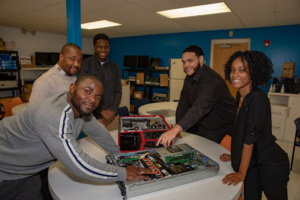 Another way for tech companies to promote their workforce diversity is to develop their talent pools from the inside out, by offering upskilling and specified training programs designed to create representation, as well as opportunities for those who may have otherwise been overlooked. Tech is a fast-growing, constantly evolving field. By upskilling existing employees or groups of employees in needed areas, a tech company benefits itself by staying up-to-date and responsive to tech and market trends and benefits its employees by increasing their skillsets, experience, and earning potential. This practice also provides pathways to success for employees of all backgrounds and skill levels.
Finally, beyond hiring and training, it is important for a workplace to support and facilitate the growth and development of its budding tech talent by providing mentorship opportunities. Mentorships can help fresh learners make connections, grow their skills, gain confidence, and ultimately pave the way for growth and success in their respective career paths. If done right, this can have the effect of increasing productivity and work quality, while also boosting minority inclusion and representation in the workplace.
How Per Scholas Increases Diversity for Employers
Studies have shown that organizations ranking high in internal ethnic, age, gender, and cultural diversity regularly and significantly outperform their industry peers in terms of financial returns and employee satisfaction. “More diverse companies, we believe, are better able to win top talent and improve their customer orientation, employee satisfaction, and decision making, and all that leads to a virtuous cycle of increasing return,” a recent McKinsey report stated. The business case for diversity is strong, as is the social one. It is now up to companies to put in the work to improve the diversity of their workforces, and Per Scholas is happy to help along the way.
Since its launch in 2016, Per Scholas’ Diverse by Design initiative works with employers to open a solutions-driven conversation about DEIB in tech. Initially launched as a conversation series, Diverse by Design strives to create “a space where leaders in tech and workforce development [can] come together to discuss and share best practices to attract, retain and develop skilled black and brown tech professionals.” Diverse by Design events regularly gather hundreds of attendees in cities all across the country. The initiative is led by a National Advisory Board composed of members from a wide variety of tech-adjacent organizations.

Through thoughtful, focused discussion and personalized input from DEIB experts, Diverse by Design seeks to enable C-suite leaders to make valuable and socially impactful business decisions. Diverse by Design also provides organizations with access to customized training tracks and talent sourcing solutions that allow a company to meet their own talent demands while simultaneously transforming the diversity landscape within their company.
Ignite a Passion for Tech with Diverse Learners
Per Scholas is committed to preparing individuals typically underrepresented in the tech industry for successful careers in tech. An important part of this process, beyond simply preparing learners to launch their careers, is showing people from various minority-in-tech backgrounds that success is possible for them in the tech field, and opening pathways for them to succeed. Per Scholas learners of various ages, gender identities, races, ethnicities, physical abilities, and backgrounds have been able to find success through Per Scholas courses and subsequently launching tech careers. No one should be barred from pursuing a career in tech due to a lack of connection, and the success of our learners serves to encourage others to apply, breaking down barriers to entry in tech.
Many of our female learners expressed an initial hesitation in entering such a historically male-dominated field, prior to taking Per Scholas courses. However, our courses, which typically possess a high percentage of female learners, quickly break down preconceived stereotypes and show women that they can be heard, respected, and successful in tech. Per Scholas Newark learner Dekontee Milfort reflected that she saw the tech industry as one for men, that the men in her family worked in tech, but not any women. “I felt like the IT world was mostly for guys. A lot of the guys in my family – that was the job they were doing. It was a heavily-male role. A friend of mine talked to me about Per Scholas and their diverse graduates, and after looking on the website at all of the graduates, I knew this was the training for me.”
More seasoned technologists also face discrimination in the tech industry, primarily due to ageism. Many believe that tech is a “young person’s field,” and that older individuals cannot be successful in IT. This is, of course, a totally false assumption and, with the proper training, upskilling, and guidance, those individuals can be just as successful as their younger counterparts. This is proven true over and over by our many brilliant mature learners, who achieve great things both in and beyond our courses. Antwan Grant, who graduated from Per Scholas Atlanta’s Software Engineering course in 2021, had initially begun her tech career in 2000. She had not been able to upskill since then and had been stuck doing back-end work that she did not enjoy. “Being in the IT world for as long as I have been, you can get stuck,” Antwan, who worried that her age would keep her from advancing in tech, reflected. “Fast-forward 3 months and I have graduated from Per Scholas! I felt so accomplished with everything I was able to figure out – I know now that I can do this! With my old skill set, no one would hire me. Since graduating from Per Scholas, I have had people contact me for jobs right here in Atlanta.”
I am very grateful; not only for the opportunities that Per Scholas has presented to me but for the opportunities that they provide to people in communities that don’t have the same opportunities that other communities have.— Moja Chatman, Per Scholas New York Graduate
 Our learners are all talented and driven individuals, many of them simply lacked prior opportunities to become involved in tech. Moja Chatman, a recent graduate of our Bronx AWS/reStart course, is a born and raised New Yorker. He was always interested in tech but never had the opportunity to pursue it professionally until he came across Per Scholas. Moja landed a job shortly after graduating and is thankful for the doors his training was able to open for him, and others like him. “I am very grateful, not only for the opportunities that Per Scholas has presented to me but for the opportunities that they provide to people in communities that don’t have the same opportunities that other communities have,” Moja reflected.
Ultimately, the promotion of diversity, equity, inclusion, and belonging in the tech workplace begins with opportunity and intentionality. The IT field still has a long way to go in order to become a totally diverse and inclusive community, but it is certainly headed in the right direction. Per Scholas is committed to being a driver of this change, transforming the face of technology by opening pathways of opportunity for diverse talent and helping other organizations to do the same. As a champion of diversity, DEIB is in our DNA.
How Women In Tech Are Launching Their Careers
It is discouraging that there are far fewer women involved in IT and tech-related fields than there are men. The latest study by the AnitaB.org Institute found that women make up just 28.8 percent of the tech workforce. Tech, like other STEM fields, has historically had a reputation of being “for the boys,” and women face many barriers to entry, including workplace discrimination, unequal pay, and a lack of female tech role models to inspire them. Plus, the pandemic continues to negatively impact women in the workforce, and women of color in particular. Thus, even well-qualified women may be discouraged from entering the field — a detriment not only to those women but to technology as a whole.
Why It Matters & What Can Be Done to Fix Gender Inequity in Tech
Per Scholas is committed to changing the narrative for women in tech. By encouraging and providing opportunities to women learners, Per Scholas is working toward greater gender equity in the tech industry.
To encourage women’s involvement in tech, women need to know that success is possible for them in the field, and to see other women thriving in tech positions. “Success in the field is not based on just intellect; it’s based on exposure,” said Carla Davis, a 2020 graduate of Per Scholas Boston’s AWS re/Start course. “Hopefully, I can be some kind of example for others, but it was extremely difficult to get my foot in the door. The instructors and courses at Per Scholas showed me that if I worked hard, it is possible to get the certifications and get the jobs.”

Why Women Thrive in Tech
There is an aspect of support and flexibility that empowers women in the workforce to succeed and do well in their roles. Women are usually caretakers of their household, mothers, and chief operating officers of their homes, which calls for support from their employers in ways beyond financial support. We know that when women have flexible hours, remote work location flexibility, support for caregiving and child care, they are able to provide for themselves and their families and better focus on their careers and training at Per Scholas.
Per Scholas Scholarships & Grants for Women in Tech/IT
With generous support from partners, Per Scholas has been able to make real progress in improving the gender balance of our learners. Per Scholas has enrolled more than 1,800 women learners since the start of the pandemic in 2020, and it’s a number that only continues to grow.
Last fall, Per Scholas was selected as one of five recipients for the Women in Apprenticeship and Nontraditional Occupations grant, presented by U.S. Secretary of Labor Marty J. Walsh. “For too long, women have faced barriers to gaining entry into apprenticeships and nontraditional careers,” Secretary Walsh said at the grant presentation. “As we work to build back a better economy, these grants will empower women to get the training and support they need to secure good-paying jobs and pathways into the middle class. They are an important and effective tool for creating a more inclusive and equitable workforce.”
Women in Software Engineering (WISE) Apprenticeship
As a result of this grant, Per Scholas has launched a new Women in Software Engineering (WISE) Pre-Apprenticeship training track from our National Capital Region (NCR) Campus in the Washington, D.C. metropolitan area. With additional support from Capital One, The Boeing Company, and Montgomery County Economic Development Corporation, our first pilot cohort is launching this month. “We have the opportunity to learn so much from our WISE learners,” said Diane Duff, Per Scholas National Capital Region Managing Director. “We’ve received generous support to adjust our already proven model to more effectively address the unique challenges facing women who want to enter the tech industry.”
It is incredibly powerful to see our efforts pay off. In 2021, more than 35% of Per Scholas learners identify as women, an increase from the previous year. “I have noticed that there are a lot fewer women in tech than there are men,” said Soma Majumder, a 2021 graduate of Per Scholas New York’s IT Support cohort. “But from my experience, I didn’t feel that there was any barrier when I entered the tech industry; I think a lot of that had to do with Per Scholas and how adamant they were in getting us placed in jobs. I think that I was really lucky to have my career coach and the business solutions team there because they really pushed for me and were really active in helping me get a job.”
COVID-19 Recovery for Women in Tech
This International Women’s Day, the Franklin County Board of Commissioners in Columbus, Ohio, committed to developing the county workforce to meet a growing demand for technology jobs by voting unanimously to approve a more than $4.5 million COVID-19 recovery grant to support the new Tech Women of Color workforce training initiative at our Per Scholas Columbus campus.
“We are grateful to the Franklin County Board of Commissioners for providing us the opportunity to be of service to our community, and to our local partners who will come alongside us as we seek to make a transformative impact in this county,” stated Jenn Fowler Howard, senior director of the Tech Women of Color Alliance at Per Scholas. “We recognize that this project will not only change the lives of the women who participate but will also build stronger families, communities, and businesses for years to come.”

Looking to The Future: More Women Learners
We are excited to see the heights our women learners will reach in the coming years as we continue to strive to achieve a more gender-balanced tech workforce. Women can succeed in tech, and we are committed to providing the tools and opportunities for more and more of them to do so.
“I gained so much from my experience with Per Scholas,” Per Scholas Philadelphia alumna Susan Tabassum reflected on her experience in the program. “It reinforced the knowledge I already had in technology, I gained a lot of new skills, and, most importantly, it gave me the confidence to pursue a career in technology, which is what I’ve always wanted.”
How to Set Goals That Will Help You Succeed
In general, setting goals is an integral part of life. Creating individual goals can help you outline a path to obtaining a long-term vision and provide motivation and guidance throughout the process. Goal-setting is one of the many exercises in which a mentor’s direction can benefit. We gathered a small list of Per Scholas’ mentors’ most essential tips to help you set and accomplish your goals.

1. Start with small goals.
Get your foot in the door by setting and accomplishing small, achievable goals. These will help you build up the habit of setting and meeting goals without feeling too overwhelming right off the bat. Regularly achieving these small goals can help you gain the momentum, motivation, and confidence you need to make the jump to bigger, more complex goals successfully.
2. Adopt some behavioral micro-habits.
Like small goals, micro-habits are small, simple tasks that allow you to break down the components of a more prominent goal behavior into tiny, achievable parts. Micro-habits never last longer than 3-5 minutes, but they are mighty! These habits aim to assimilate small, proactive behaviors into your daily life to the point where they become a habit, cumulatively achieving your overall goal. If, for example, your overall goal behavior is to become more organized, you can adopt some quick micro-habits as simple as making your bed in the morning, hanging your jacket up when you get home, rather than throwing it on that chair, planning out your next day the night before, etc. Setting micro-habits can grow the confidence and ability to achieve more necessary life goals and behaviors. Starting small instead of making drastic life changes feels much more achievable and can help you build the consistency that will help you achieve your overall goal behaviors.
3. Set your aim and get started! Remember that your goals may change and grow with you.
Setting goals that will tangibly impact your future can feel stressful and daunting. However, it is essential to understand that your goals will change and evolve with you. This does not mean that you failed to accomplish your original goals. Instead, it means that you learned enough in the process to grow and develop your plans. Coming up with your first set of goals doesn’t have to be an overly arduous process, but it is crucial to have a starting point to work from. Monitoring the growth of your goals over time will allow you to look back on your progress and set the launching pad that you can build from. As Kelsey Briggs, Per Scholas Chicago’s Senior Manager of Business Solutions put it: “as you learn more about yourself and your field, [your goals] may change. But, you can’t see where you’ve come from, where you’re going, or even know if you’re on the right track if you don’t set those first goals.”

4. Set SMART Goals
The goals you set for yourself must be clear and achievable. Vague, overly-aggressive, or poorly-framed goals are a quick recipe for frustration and disappointment. “SMART goals” is a system designed to help you set the framework for success by crafting goals that are clear, trackable, and carefully planned. The components of SMART stand for: Specific, Measurable, Achievable, Relevant, and Timely. In a nutshell, you want to ensure that your goals are realistically accomplishable, as clear and specifically-defined as possible, relevant to your overall values and interests and that your progress can be measured in some way and completed within an ideal time frame. Setting up the framework to define and achieve your goals is a foolproof first step in the process of accomplishing your goals. Plan out your goals, follow your plan, and you will set yourself up for success.
5. Be Intentional.
To achieve your goals, you have to be mindful of your actions, time, and effort. Achieving goals is a significant accomplishment, and it can be done by following the plan that has already been set. Remind yourself of the big picture, keep your goals close to you, and don’t forget to check in with yourself to make sure you are following your plan and that you are on the right track to success. It is equally crucial to be kind to yourself when you are not following your plan. Goal-achievement is not always a straight line; if you find you are slipping, remind yourself why you have chosen to follow this path and what the benefits of success will be. Everyone has off days, and it is essential not to let them overwhelm you. If achieving your goals was easy, these tips would not be necessary! Forgive yourself for slipping and identify what specifically caused you to do so. Reassess and make changes to your technique if necessary, recommit yourself to the end goal, and get back on track!
With these tips in mind, you should be ready to start setting and working towards your goals! Remember to be realistic and intentional with the goals you set and to hold yourself accountable for your progress. Everyone has to start somewhere, and even the smallest goals can be an important stepping stone to bigger things.
A Mentor’s Role in a Learner’s Life
A career mentor’s role in a student’s life is highly significant. A mentor is someone who guides a learner throughout their journey to break the barriers that might stand in their way to success.
Per Scholas offers supplemental mentorship to all its learners in addition to their training. Our mentors are career coaches, financial coaches, and instructors, all of whom believe that maintaining an open line of communication with our learners is essential to their success. But how exactly are mentors influencing our learners’ experiences not only during their time at Per Scholas but also after graduating? How are our learners prepared to navigate a job market that grows continuously and becomes more demanding every day? Hear from some of our Per Scholas’ mentors about the benefits, activities, and advice for career success.
How Mentors Help Learners
One of the many ways a career mentor can help our learners is by ensuring that they are equipped with proper knowledge and skills necessary to be marketable in the workforce, as well as enhance confidence in areas that learners might feel incompetent in, and accommodate time outside traditional class to provide a more personal learning experience.

Mentorship can be as broad or as specific as learners need it to be. One way Kelsey Briggs (Senior Manager, Career Solutions, Chicago) provides mentorship is by sharing information about job market opportunities in the area and also offering feedback to learners about their job search materials, networking, and communication skills.
“We guide them through their next career move, salary negotiation, and even when the right time is to move on to a new opportunity.”
It is also important to remember that the relationship between mentor and mentee, in this case, our learners, is a safe, free of judgment space, and encourages learners to share their personal challenges and create an effective plan of action. “I focus on mentoring my learners with my life expertise and best professional practices. I also hold one on one meetings with my learners, and together we create an effective plan to address them,” shares Jose Jurado (Senior Manager, Career Advancement, New York).
What to do as a Mentor
It is essential to understand what activities learners can participate in with their job mentors during the mentoring process. Our mentors in Boston and Detroit agree that having a set time to connect and check in regularly is fundamental to building a fruitful relationship between mentor and learner. Equally important is to talk openly. Honest feedback is one of the many benefits of mentorship. However, this can only be effective if there is an open communication line between the career mentor and the learner. As Kelsey Briggs explains: “As we get to know each other, we can offer information on how others might perceive us, how we could get ahead, or how we can reach our goals. The mentor/mentee relationship isn’t fixed, either. A strong relationship will have you sometimes offering advice and sometimes receiving it.”

Other suggested activities include role-playing, which can be beneficial during the interview process when looking for a job, setting reasonable expectations, providing career focus direction, and networking activities. Many other activities can be part of your job mentor’s relationship; these will depend on what you need, what you are looking for, and where you stand in your career at the time.
The Importance of Digital Upskilling and Reskilling
In a competitive job market with many shifting gears from The Great Resignation, there is more focus on employees to upskill and reskill in their industry to become greater experts in the field.
When it comes to technology, Per Scholas not only trains our learners to become skilled technologists, but we also offer digital upskilling and reskilling opportunities that support our corporate partners with top-tier candidates for their organizations.
In this article, we will cover what digital upskilling and reskilling is, why it is important in the tech industry, and what courses Per Scholas provides for such skills. Read on to find out how Per Scholas can help you navigate the great resignation and move your career forward.
What is Digital Upskilling?
Digital upskilling refers to the process of acquiring new digital skills to enhance one’s existing skill set.
For example, if a technologist has basic coding skills, they may want to upskill by learning a new programming language like Python or JavaScript, or they may want to acquire new skills in web development, cloud computing, or data analytics. Digital upskilling can help individuals stay up-to-date with emerging trends and technologies, increase their marketability, and boost their career growth. Per Scholas offers advanced technology courses in cybersecurity and IT Support for learners and alumni.
Upskilling vs Reskilling: What’s the Difference?
Digital upskilling refers to the process of acquiring new digital skills to enhance your current expertise, such as learning a new programming language or mastering a new software tool that builds on your current experience. For example, a marketer might upskill by learning how to use data analytics tools to better understand customer behavior.
On the other hand, reskilling involves learning an entirely new set of skills to switch to a different job or career. For example, a factory worker might need to reskill to become a software developer.
In short, upskilling is about enhancing your current skills, while reskilling is about acquiring new skills for a new job or career.
Why is Digital Upskilling Important in the Tech Industry?
The industry is ever-evolving and simply put; the more you know, the more you grow. From a business perspective, it is alluring to hire individuals who are eager to learn more or have previously done so to further their careers.
Luckily, Per Scholas prepares our learners for thriving tech careers with these opportunities.
Per Scholas Digital Upskilling Opportunities

Navigating the Great Resignation with Customized Training
Throughout The Great Resignation, Per Scholas has been able to navigate the new industry challenge and help our enterprise clients through our customized digital upskilling training and reskilling courses.
Our Chief Enterprise Solutions Officer Damien Howard was recently invited to serve on a panel at The Big Exit Conference and spoke on how Per Scholas is helping companies win the War on Tech Talent:
“We’re all facing a war on talent amid the Great Resignation, so the opportunity is right in front of us to make diverse, equitable, and inclusive hiring decisions that will push business — and bottom lines — forward,” Damien mentioned during his panel discussion.
Not only are we providing strong tech talent for our partners, but a diverse group of technologists that will bolster Diversity, Equity, and Inclusion efforts for corporations.
The IT industry is struggling with diversity, where only 40% of the IT workforce is diverse today and only 26% is women. There is limited supply and high demand for diverse candidates, which is what Per Scholas has worked to bridge a gap in the workforce.
A study conducted by the Boston Consulting Group (BCG) identified diversity as a key driver of innovation, finding that diverse teams produce a minimum of 19% more revenue
A Digital Upskilling Success Story: Maria Patokina
Per Scholas graduate Maria Patokina took advantage of one of our upskilling courses that advanced her coding capabilities. After successfully completing her initial course in March 2021, Maria did not have a job lined up, so she felt it was important for her to continue learning and gain certifications.
Maria enrolled in the Google IT Automation with Python Alumni training course. “The Python certification helped a lot in several ways,” she reflected. “Taking this certification course helped me better understand general coding principles and other languages, like Javascript.”
After completing the course in May 2021, Maria realized that the new certification made her a standout candidate in her job search. She soon began her first tech job as a Software Engineering intern at a leading corporation.
Maria credits the certification for improving her coding skills and creating a habit of self-studying that she feels is important in the IT field. “I learned a lot in a short period of time with Per Scholas that prepared me with a lot of practical, hands-on experience,” Maria said about her experience.
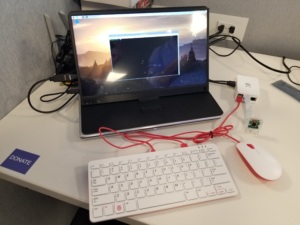
Start Your Digital Upskilling and Reskilling Journey
With so many different avenues to go down in the tech field, upskilling and reskilling opportunities are pertinent for both companies and employees.
Per Scholas’ alumni training courses that have been customized for our partners are one way to defeat the Great Resignation we have recently faced in America and a great opportunity for organizations to strengthen their DEI ties.
Data has shown that 87 – 90% of our learners are people of color and about 30% of that number identify as women, further proving we’re a turnkey solution for enterprises looking to diversify their technology talent immediately – with customized courses and opportunities for our graduates to continue towards success as technologists.
For more information, visit our upskilling opportunities page. For questions about diversifying your tech talent pipelines with our incredible talent, set up a discovery meeting to discuss how we can work together and move the needle around diversity, digital transformation, and superior tech talent within your firm.
Financial Planning Tips
Per Scholas is dedicated to connecting our learners with tuition-free tech training designed to launch them into thriving tech careers. Upon completion of training, our graduates are often able to take on roles that allow them to earn a higher income than in their previous employment, as well as access new financial opportunities. Per Scholas is unique because we not only provide tech training to our learners, but we also offer them the services of financial coaches to help with financial planning and wealth management. We tapped into the expertise of our financial planners to obtain their top five tips for financial planning.
As part of our Learner Support Team, Per Scholas’s financial coaches are available to guide our learners and provide advice on all manner of finance-related matters, from saving money to budgeting and more. Our financial coaches are dedicated to helping our learners navigate their individual financial situations, as well as setting our learners up for future success in taking their financial planning to the next level.
1. Consider Your Financial Needs
Financial planning is not a cookie-cutter, one-size-fits-all approach. To start budgeting and saving money, you need to consider what is important to you and why. Beyond basic necessities, each person will have their own things that are important to them to allocate money for. Furthermore, depending on factors such as where a person lives, the size of their family, etc., even planning for necessities will vary by situation. A financial plan that works excellently for one individual may not be applicable at all to another person.
It is necessary to remain open to new ideas when considering your own financial needs. This will allow you to make better plans and decisions about managing your finances. It is also important to understand that you may need to make some difficult financial decisions and sacrifices in order to achieve financial freedom. In financial planning, Brenda Badger, Per Scholas’s Senior Manager of Financial Coaching stated that “the most important thing is to be willing to learn and have an open mindset to adopt new habits, processes, and information learned.”

2. Create emergency savings, then save for anything else
When we spoke with our financial coaches, all of them had the same advice when it came to what percentage of your income to save: there is no set percentage that works for everyone, but it is very important to first create emergency savings. “Prioritizing emergency savings is a critical part of a sound financial plan,” Brenda emphasized. Once you have created emergency savings, you can then make sure your income outweighs your expenses and determine a reasonable percentage of your paycheck to save each month. We found more money-saving tips from The Penny Hoarder that show how small changes make a significant impact on your savings.
One way to free up money for your savings that you already have is to consider regular expenses. For example, think about what monthly subscriptions you have and if you are able to cut back on any of those. What about daily coffee runs? Perhaps you are able to reduce your coffee shop visits and save money by brewing at home. Saving money doesn’t necessarily mean you have to significantly diminish your spending on things that you do, but try compartmentalizing your finances so that you can precisely see where you are able to make adjustments. Do you currently have an emergency savings fund? If so, how did you build it, and what, if any, changes did you make to your regular spending habits in order to do so?
3. Create a budget based on your income and goals
How does one start a budget? What may seem like a big task can actually be exciting! Here are some top budgeting tips from Per Scholas’s financial coaches!
- Track all of your spending for one week and use that as a starting point for your budget. It’s important to know where your money is going and how to strategize around reducing debt, saving for big purchases, and investing in your retirement.
- Create a list of all the things you spend money on (bills, fun, transportation) and calculate the amount you think you pay every month. Track your expenses over a month and compare what you think you spend to what you actually spend. Adjust the amounts, so they reflect what is really happening and what you want to happen.
- Budgeting is something that should be done before spending so that there is a plan in place and you know your needs are covered, your goals are addressed, and your wants are permitted.
- Start with your income and include your fixed and variable expenses. Factor in your emergency savings, your future goals, and a miscellaneous category for the unexpected.
- Make your budget match your paycheck schedule. If paid bi-weekly, your budget should be divided into two groups to coincide with the two paychecks you receive each month.
- Track your progress and reward yourself when you reach milestones!

4. Make SMART financial goals
You should handle your financial goals as you would any other goals and make sure they are SMART – Specific, Measurable, Attainable, Relevant, and Time-Bound. Per Scholas Financial Coach Manager Janell Pollard gave great insight with the example of a particular goal of buying a car. “I think it is important to set yourself up for success by testing out things before you commit,” Janell advised. “If you think you can afford a $350 [per month] car payment, practice saving that amount for six months. If you can do it comfortably, you can probably afford the car payment, and you can use the six months of savings (350 x 6 = 2,100) as a down payment. If not, you just saved yourself from making a financial decision you probably couldn’t afford.”
Consider each of your financial goals. Write them down, then break them down. For example, if one of your goals is to put money into a savings account, consider amplifying this goal to be a SMART goal. Review the SMART questions posed above and consider how these questions apply to the goal of saving money. How much do you want to save? When do you want to have that amount saved? How much will you put away monthly in order to reach that goal in the time you allotted? Are you able to achieve this goal without compromising your current finances? With relevance to your life, how will this goal help you? These are all ways to consider your goals and strengthen your ability to meet them in the time needed. What are some of your SMART financial goals?
5. Find a financial planner to map out your wealth management and money goals.
A final tip for financial planning is to connect with a financial advisor that works well for you. Brenda suggested, “find a Financial Coach you trust and gel well with. Simply having this type of professional in your corner to inform you, support you, and cheer you on might be the boost your finances have been waiting for!” Remember to keep an open mind and be open to new ideas that may be challenging to implement but worthwhile for your future!
Budgeting your money and planning for your finances is necessary, but it does not have to be a daunting task. Our Per Scholas learners are fortunate to have access to excellent financial coaches from our Learner Support Team, who help learners navigate their finances during and beyond their time at Per Scholas. “Per Scholas offers a lot of services to help the learners manage their finances,” recalled Ivan Reyes, who graduated this year from Per Scholas Boston’s IT Support course. “I really was able to take advantage of it, and I’m very grateful for it. It’s good to have that extra help, and it lets you focus on what you’re doing. It’s given me the confidence and peace of mind to go out there to find a job that’s really the right fit for me.”
When it comes to planning so that you can achieve financial freedom, remember to keep your goals in mind. Whether you are putting $100 a month towards your savings, paying off prior debts, managing a family, or saving up for a particular purchase, each financial goal will be unique to your personal finances. Tackling your finances does not have to be a frightening task; with the proper guidance, it can be educational, informative, and invigorating. Find a budgeting app that works for you, a financial coach that understands your goals and level of financial literacy, and discipline yourself to stay on track with your financial planning. A recent study from Charles Schwab found that 18% of people who did not have a written financial plan felt confident that they could reach their financial goals. In comparison, 54% of people with a written financial plan reportedly felt ‘very confident’ that they could achieve their financial goals.
Per Scholas Celebrates Hispanic Heritage Month
Hispanic Heritage Month celebrations are underway around the world and at Per Scholas! The occasion, which runs from September 15 to October 15, is a time to celebrate all of the culture and unique heritage that makes up our Hispanic communities and connect us all to each other. It has been a focus of ours to connect Hispanic learners with top tech companies to help launch them into a career in technology, as they are historically underrepresented in tech.
To kick off Hispanic Heritage Month, our President and CEO Plinio Ayala shared a message with our team and encouraged us all to use our shared experiences as a way to connect with one another. He also tapped into his own story as a New York Latino. Plinio grew up in a close-knit neighborhood in the South Bronx, with representation from various Hispanic communities, including Puerto Rican, Mexican, Dominican, Honduran, and others. He related this story of his first trip out of the Barrio recently to Nia Darville, Director, Diverse by Design, as part of the DxD podcast series. Here, he spoke about why what we do at Per Scholas is so important to him on a personal level and the community he came from. Plinio’s story resonates all the way through our Per Scholas team and the learners we interact with as we train them for different IT roles and responsibilities.
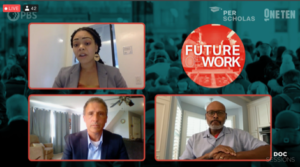
Earlier in September, one of our Hispanic learners on track to launch his technology career, Richard Escotto, was featured on CBS Sunday Morning. The feature focused on how many industries and labor markets are looking for employees following the pandemic and where those employees are working now. Richard Escotto mentioned that after he lost his restaurant job at the beginning of the pandemic, he decided to change career paths into technology. “[The pandemic] did give me an opportunity that was rare and probably was never going to happen, and sometimes you just have to seize that,” Richard reflected.

Richard Escotto is set to graduate from Per Scholas New York in October 2021 from our Cybersecurity course. Since the beginning of 2021, we have trained 300 Hispanic learners for our tuition-free tech training program, a growing number that Richard is happy to be a part of.
The Return to Campus Begins
After nearly a year and a half of remote training, virtual camaraderie, and reminding people they’re on mute, Per Scholas campuses began opening their doors to welcome our learners back to in-person learning in July. Complete with social distancing and health and sanitizing protocols in place, Cincinnati, Columbus, and National Capital Region were the first of our seventeen campuses to host our cohorts in-person. This is the start of our beginning steps as we roll out an initiative to re-introduce our learners, national staff, and campus teams on-site. Don’t think we will forget what we’ve learned from the pandemic, though; Per Scholas mastered the art of remote training and will continue to use it to reach more individuals moving forward.
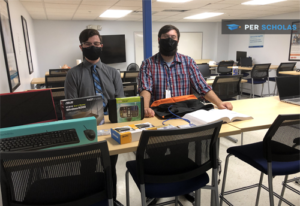
The return to campus for our learners is an experience that won’t be taken for granted as we continue to monitor the health of those returning, wear masks, and provide sanitizer for all. If there is one thing the pandemic and remote training taught us, it is that the resiliency of our learners and campus teams is unparalleled. We know that our learners can take on anything—we’ve seen that from the many challenges learners overcome before even arriving at Per Scholas, throughout in-person training (pre-pandemic), and in the initiative and resilience everyone showed both when we went remote and now as we return to campus.
While it may have been great logging into Zoom from the comfort of home and wearing sweatpants as the bottoms of our professional attire, there is absolutely nothing that compares to the interaction and experience of in-person training at Per Scholas. Per Scholas Cincinnati Managing Director Jay Dierig reflected that since returning, “Being back on-site has been a great experience for both our staff and learners. With tremendous effort and innovation, we made the pivot to deliver our courses in a remote environment, but there is nothing quite like the interaction, hands-on learning, and sense of community we can create with in-person experiences.” Just as our learners will pave the way in the tech industry once they graduate, they will now pave the way for our organization as we transition back in-person for our national staff as well.
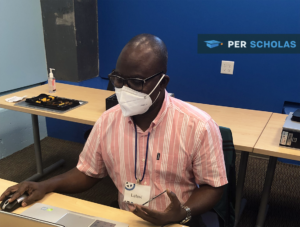
The morale that in-person training has created is second to none after being virtual since March 2020. Jay Dierig has noticed that the learners and campus teams are thrilled to be back as they build career paths in technology and advance economic mobility. “I’m delighted to be back in our beautiful building at Citylink and love to see the look of excitement on the faces of our learners each morning,” Jay mentioned. “Providing a safe, inclusive, and inviting environment for our staff and learners will continue to be our top priority.”
As we continue to welcome smiling faces back into our campuses across the country, we are eager to connect our diverse and skilled learners with leading businesses just as we have for the past 25 years. We’ll all miss reminding our colleagues they’re on mute at least once a day, but we think the trade off is worth it.
Growing to Train More Learners Nationwide
In June, Per Scholas made waves and became a greater source of technical training and career development through several important partnerships, recognitions, and collaborations. With such opportunities to grow and be recognized for the work we are doing to connect skilled individuals that were previously underrepresented in the tech community, our reach is set to grow in the coming months and years.
We’re humbled by growth capital investment from The Studio @ Blue Meridian, an initiative by Blue Meridian Partners, which provides social sector organizations flexible resources so we can test, iterate, and refine our model in order to accelerate readiness to significantly scale. Blue Meridian joins Lever for Change and other critical supporters in powering Per Scholas’ growth to 10,000 learners per year by 2025.
With our Champion Partner, TEKsystems, we graduated our first in-person training since the pandemic began! Learners in New York completed a new customized Low Voltage Technician training program developed specifically for TEKsystems’ career opportunities. We also hosted graduations in Detroit, Chicago, Boston, and Pittsburgh, resulting in over 75 trained Java Developers and Desktop Support skilled workers, ready for full-time employment.
Per Scholas was named a talent developer by OneTen, a coalition of leading executives who are working to change the approach to recruiting, hiring, advancing and promoting talent to put skills first. Our mission to advance economic equity through rigorous training for tech careers and connecting skilled talent to leading businesses goes hand-in-hand with OneTen’s vision to upskill, hire, and advance one million Black Americans over the next 10 years. “We look forward to having Per Scholas join us as an endorsed talent developer to support us in our mission to hire and advance one million Black talent in the next ten years,” said Maurice Jones, Chief Executive Officer of OneTen. “This effort will require a high functioning, multi-disciplinary coalition from corporate America, talent developers, Black talent, talent supports, and others, and it is crucial we have high quality partners like Per Scholas on that team. We are grateful for the work they have already done and are excited to partner with them going forward.”
In June, we also celebrated the launch of a new New York Satellite Partnership Initiative, removing barriers to better train learners across New York City. Per Scholas New York Managing Director Abe Mendez joined Staten Island Borough President James Oddo to announce this exciting expansion, which will begin to train Staten Islanders in-person through a partnership with the Staten Island Jewish Community Center this fall.
We are proud to again receive a 4-star rating from Charity Navigator, recognizing our organization’s commitment to industry best practices. We are also honored to be awarded Guidestar‘s Platinum Seal of Transparency for nonprofits, a recognition we are extremely grateful to receive. These awards and recognitions enable us to build trust with our partners and learners. Because of this trust, we are confident we will be successful in continuing to train and upskill underrepresented individuals for thriving careers in America’s tech workforce, achieving our goal of providing free tech training to more than 3,000 learners this year and growing to 10,000 learners annually by 2025.